Back
Back
Concrete Finance
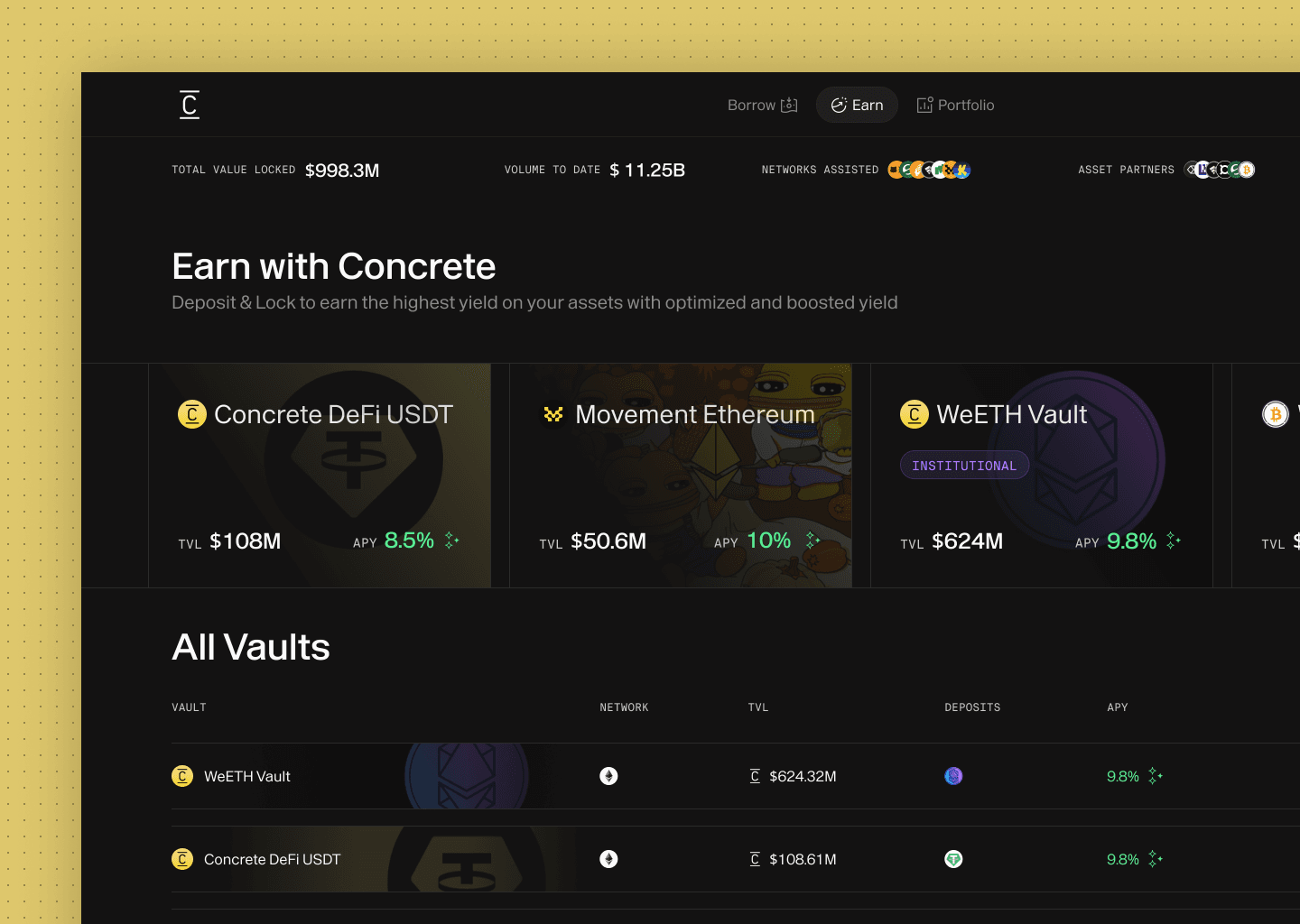
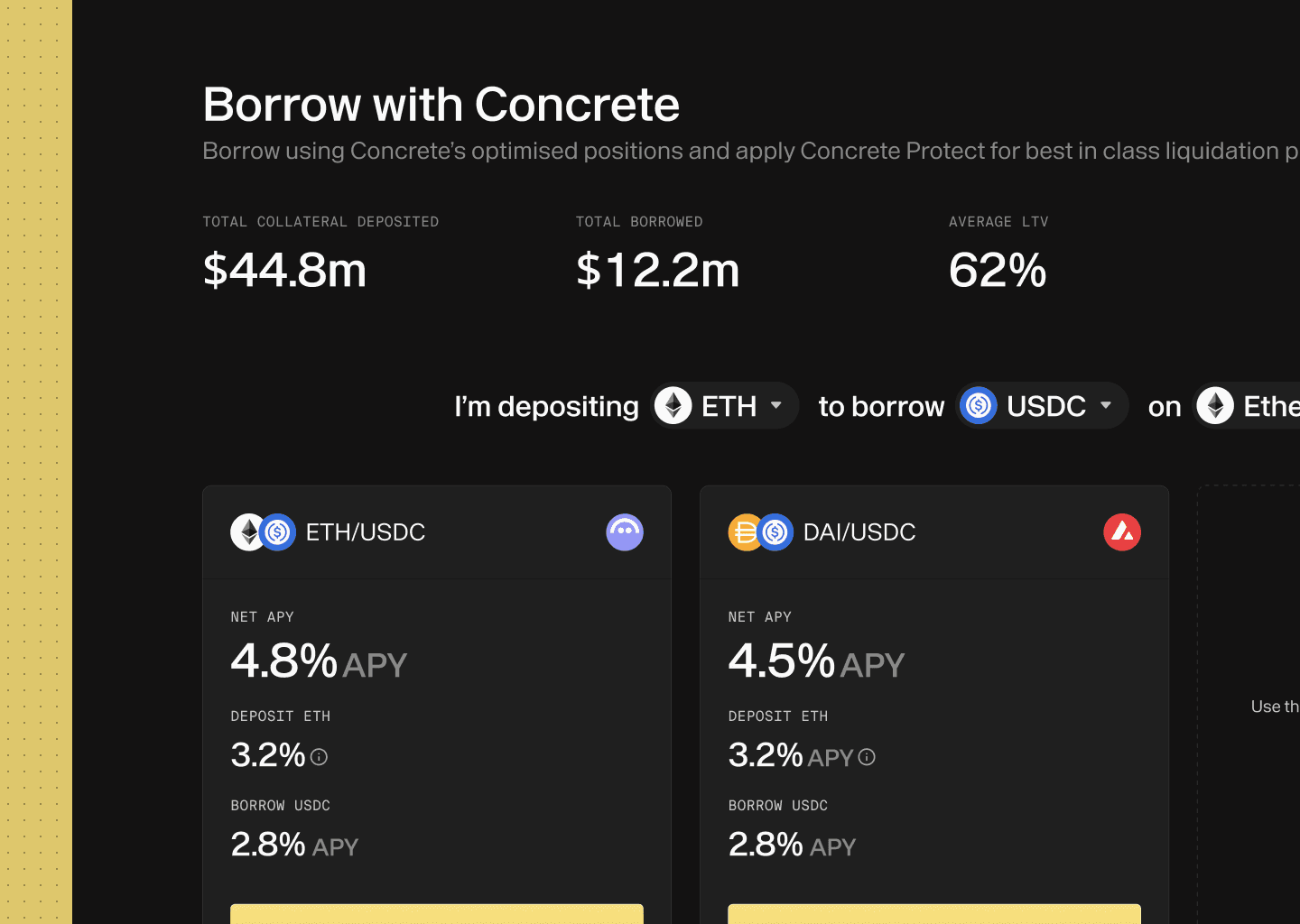
Concrete lets users borrow against crypto collateral (ETH, WBTC, and others) across major lending venues like Aave and Compound, while layering a proprietary protection mechanism on top that intervenes before a liquidation can occur.
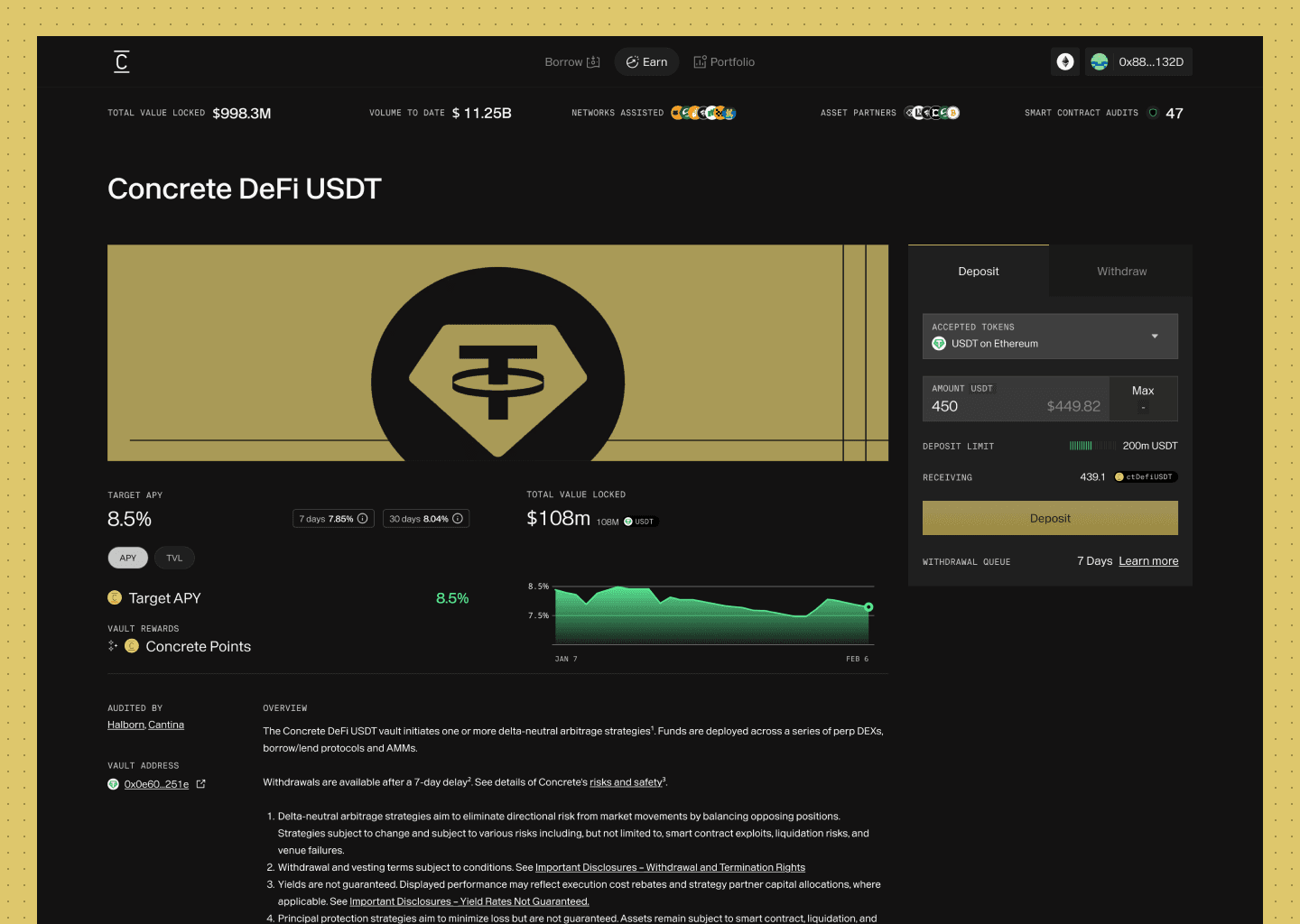
Beyond protection, Concrete also offers yield vaults that automatically route deposited assets across DeFi strategies, optimizing for risk-adjusted returns without active management. The platform targets institutions and sophisticated DeFi participants who need both capital efficiency and downside protection.
My role covered the full product surface: portfolio views, position creation flows, the protection policy system, position management, and the vault and yield experience.
Role
Lead Product Designer
Industry
DeFi · Web3
PLATFORM
Web & Mobile
TIMELINE
2024—2025
Challenge
The core problem: Institutions and serious DeFi borrowers are underserved by existing lending interfaces. Most protocols expose raw financial data without meaningful context, forcing users to manually monitor LTV ratios and act before liquidation windows close. One slow moment or missed alert can mean a 5 to 15% penalty and lost collateral.
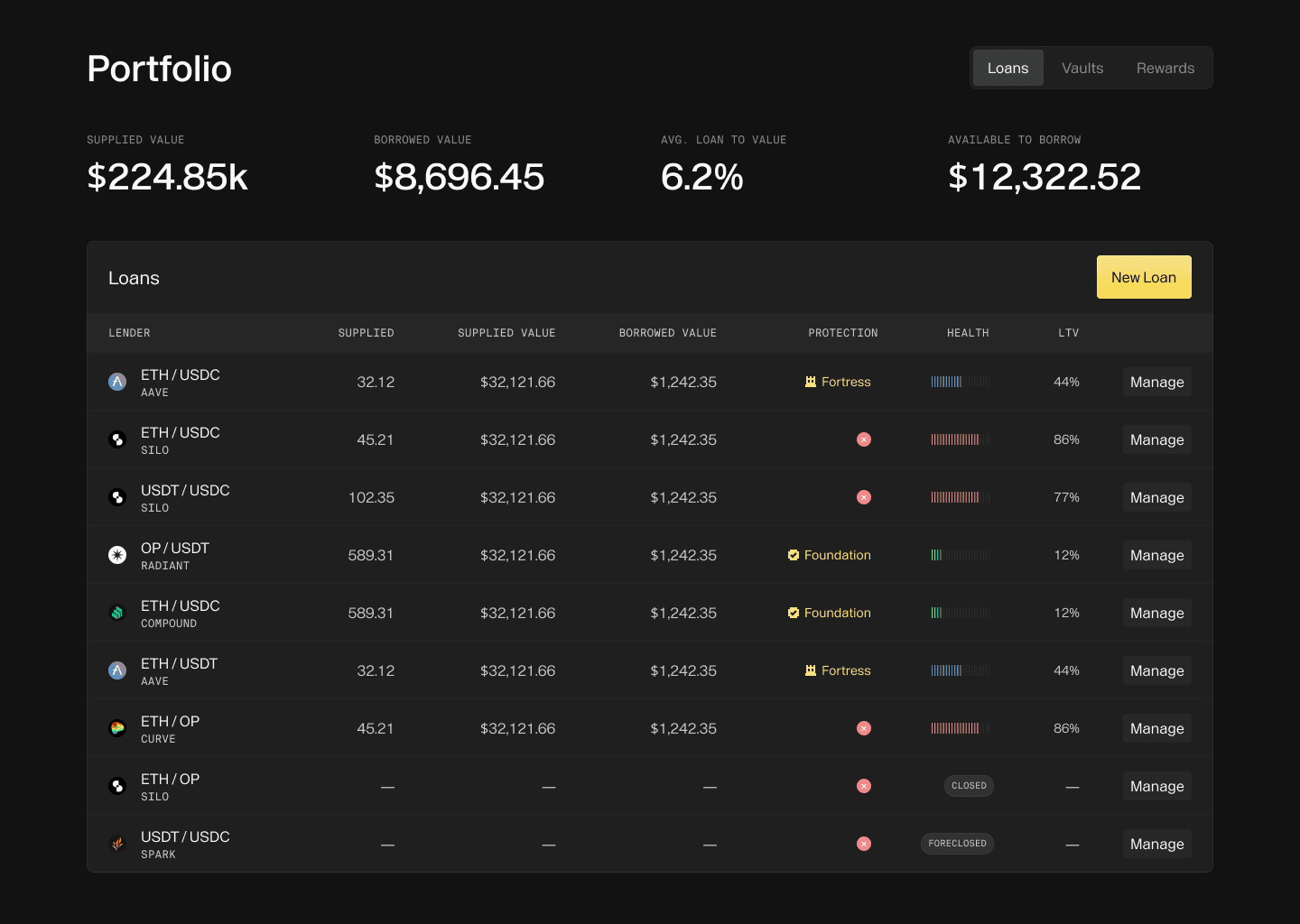
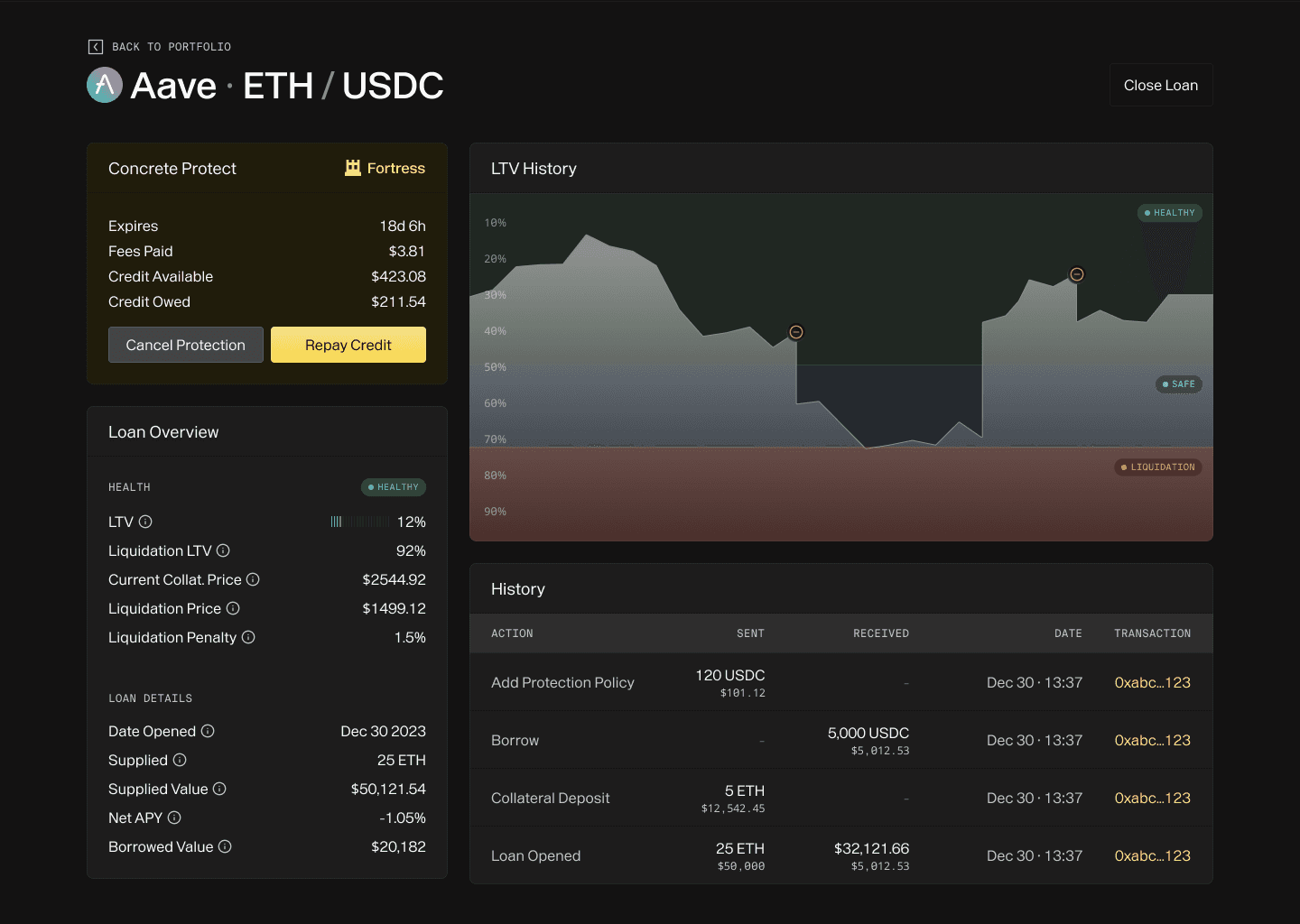
Translating complex financial state into clear UI. A position could be Healthy, Safe, Risky, or Foreclosable at any moment, each state carrying different urgency and different available actions. The interface needed to communicate this hierarchy instantly, across both a position table and a detailed position view, without overwhelming users with data.
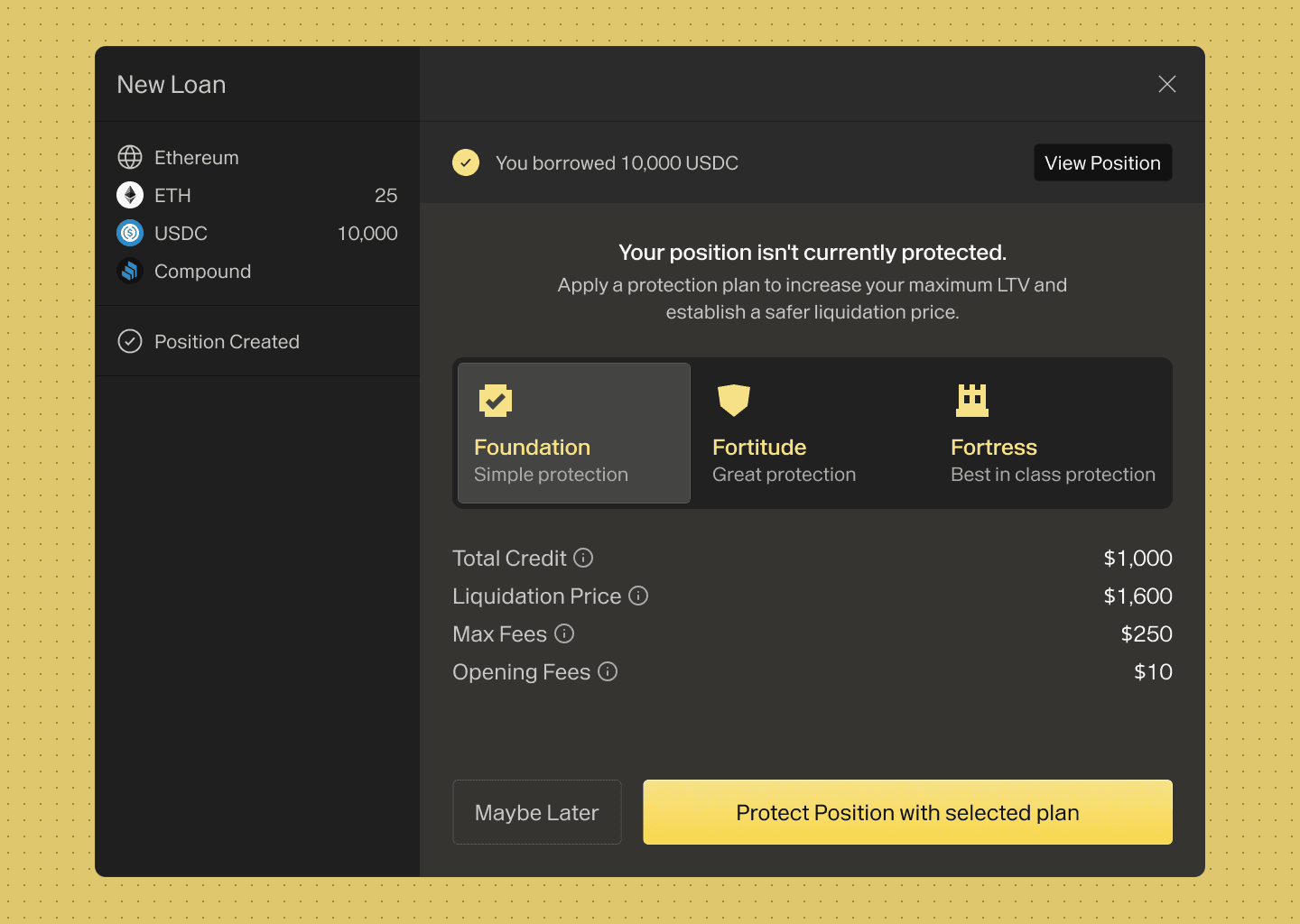
Designing a tiered protection product. Concrete's protection tiers, Foundation, Fortitude, and Fortress, each offered different LTV ceilings and foreclosure price buffers. This had to be communicated as a meaningful choice, not just a pricing table. Users needed to understand what they were buying and when to use it.
Bridging institutional expectations with DeFi conventions. The audience is accustomed to Bloomberg terminals and prime brokerage dashboards, not Web3 dApps. The design had to feel rigorous, data-dense, and trustworthy, while still being navigable by users new to DeFi mechanics.
Designing for multi-protocol, multi-chain positions. Users could hold positions on Aave and Compound simultaneously, across different assets and networks. The portfolio view needed to aggregate these clearly while preserving per-position detail for management actions.
Process
I worked embedded with the product and engineering teams as the sole designer across the Concrete product surface. My process was iterative and heavily informed by the technical constraints of on-chain systems.
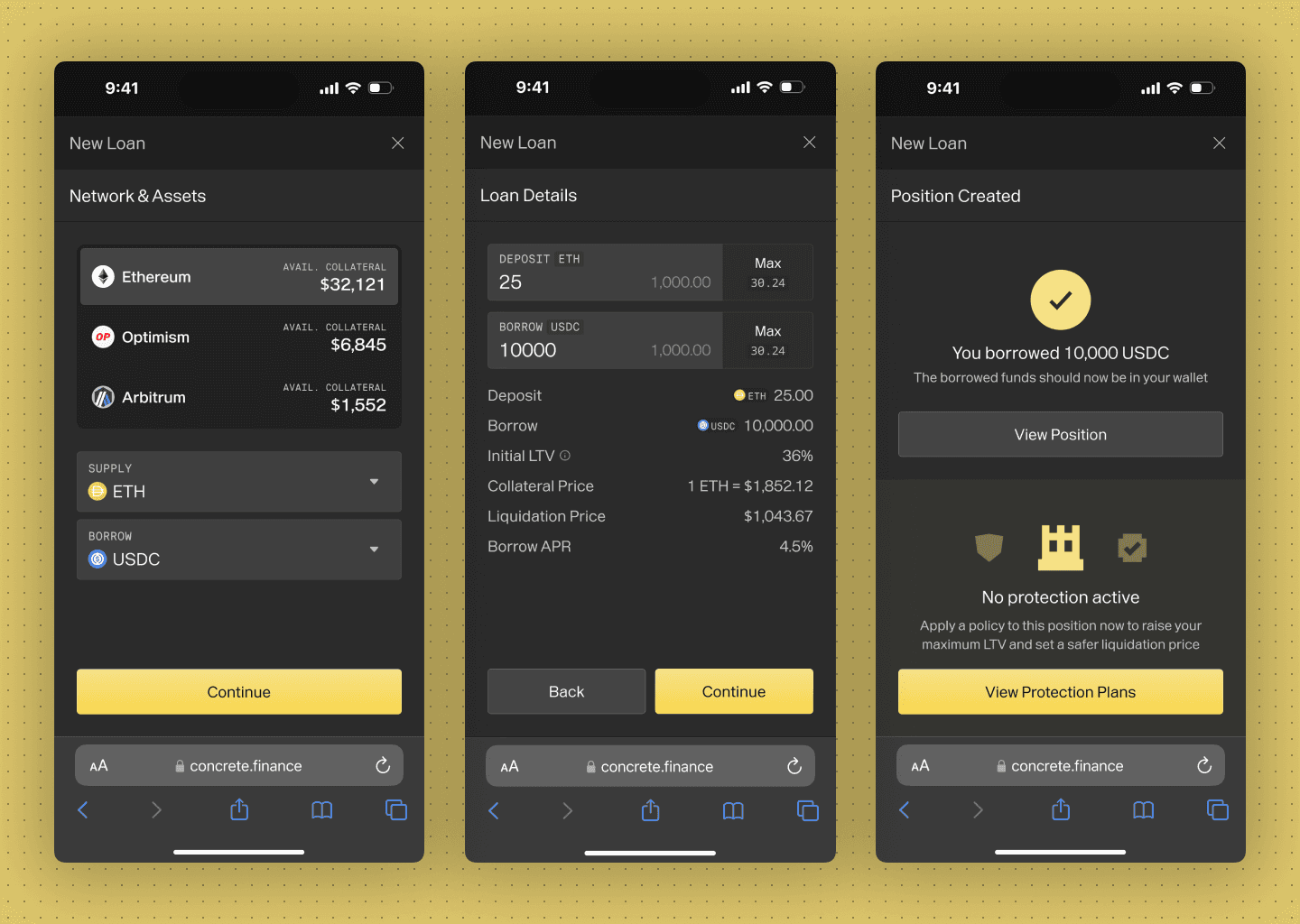
Discovery and alignment. I began by mapping the core user journeys: new position creation, protection opt-in, position monitoring, and repayment and collateral management. Working with product, I identified the highest-stakes flows as the vault strategies, using collateral for borrowing and protection policy selection. These became the design priority.
Information architecture. The portfolio view needed to surface four key metrics at a glance (deposited collateral, total borrowed, average LTV, available to borrow) while giving users immediate access to position-level detail. I structured the layout around a persistent metric bar above a sortable position table, with LTV health bars and protection plan badges as the primary scanning signals.
Position detail design. The position overview screen had to carry a lot: LTV history chart, health status, loan details, protection policy status, and all management actions (repay, withdraw collateral, get protection, cancel policy). I organized this into a two-column layout with progressive disclosure, critical health information above the fold, and historical context and detailed numbers below.
Protection tier system. Designing the Concrete Lite opt-in flow required making the three tiers, Foundation (50% max LTV), Fortitude (60%), and Fortress (70%), legible as a value ladder. I designed a card-based comparison that surfaced the key differentiator per tier upfront, with a quote refresh mechanism to reflect real-time pricing.
Modal system. Position management actions (borrow funds, repay loan, withdraw collateral, pay interest, vault swap, cancel policy) were designed as a consistent modal system with shared patterns for input fields, balance display, confirmation states, and success or error feedback.
Design system. The visual language used Enduro for display type, Suisse Int'l Mono for data labels, and a semantic color system: green for healthy, blue for safe, red for risky, applied consistently across all position states.
Outcome
Concrete launched and scaled significantly, with the platform reaching over $997M in assets under management and processing over $11.25B in total assets. These figures reflect both institutional adoption and sustained user trust in the product.
The design system established across Concrete's interface created a foundation that the engineering team could build on consistently, reducing ambiguity in handoff and enabling rapid iteration across new features. The protection tier experience in particular became a key differentiator in how Concrete positioned itself against other DeFi lending competitors.
The overall work demonstrated that institutional-grade DeFi experiences are achievable where we can design for Bloomberg-trained users and crypto-native users simultaneously, without compromising the precision or trust either audience expects.
Back
Concrete Finance
Concrete lets users borrow against crypto collateral (ETH, WBTC, and others) across major lending venues like Aave and Compound, while layering a proprietary protection mechanism on top that intervenes before a liquidation can occur.
Beyond protection, Concrete also offers yield vaults that automatically route deposited assets across DeFi strategies, optimizing for risk-adjusted returns without active management. The platform targets institutions and sophisticated DeFi participants who need both capital efficiency and downside protection.
My role covered the full product surface: portfolio views, position creation flows, the protection policy system, position management, and the vault and yield experience.
Role
Lead Product Designer
Industry
DeFi · Web3
PLATFORM
Web & Mobile
TIMELINE
2024—2025
Challenge
The core problem: Institutions and serious DeFi borrowers are underserved by existing lending interfaces. Most protocols expose raw financial data without meaningful context, forcing users to manually monitor LTV ratios and act before liquidation windows close. One slow moment or missed alert can mean a 5 to 15% penalty and lost collateral.
Translating complex financial state into clear UI. A position could be Healthy, Safe, Risky, or Foreclosable at any moment, each state carrying different urgency and different available actions. The interface needed to communicate this hierarchy instantly, across both a position table and a detailed position view, without overwhelming users with data.
Designing a tiered protection product. Concrete's protection tiers, Foundation, Fortitude, and Fortress, each offered different LTV ceilings and foreclosure price buffers. This had to be communicated as a meaningful choice, not just a pricing table. Users needed to understand what they were buying and when to use it.
Bridging institutional expectations with DeFi conventions. The audience is accustomed to Bloomberg terminals and prime brokerage dashboards, not Web3 dApps. The design had to feel rigorous, data-dense, and trustworthy, while still being navigable by users new to DeFi mechanics.
Designing for multi-protocol, multi-chain positions. Users could hold positions on Aave and Compound simultaneously, across different assets and networks. The portfolio view needed to aggregate these clearly while preserving per-position detail for management actions.
Process
I worked embedded with the product and engineering teams as the sole designer across the Concrete product surface. My process was iterative and heavily informed by the technical constraints of on-chain systems.
Discovery and alignment. I began by mapping the core user journeys: new position creation, protection opt-in, position monitoring, and repayment and collateral management. Working with product, I identified the highest-stakes flows as the vault strategies, using collateral for borrowing and protection policy selection. These became the design priority.
Information architecture. The portfolio view needed to surface four key metrics at a glance (deposited collateral, total borrowed, average LTV, available to borrow) while giving users immediate access to position-level detail. I structured the layout around a persistent metric bar above a sortable position table, with LTV health bars and protection plan badges as the primary scanning signals.
Position detail design. The position overview screen had to carry a lot: LTV history chart, health status, loan details, protection policy status, and all management actions (repay, withdraw collateral, get protection, cancel policy). I organized this into a two-column layout with progressive disclosure, critical health information above the fold, and historical context and detailed numbers below.
Protection tier system. Designing the Concrete Lite opt-in flow required making the three tiers, Foundation (50% max LTV), Fortitude (60%), and Fortress (70%), legible as a value ladder. I designed a card-based comparison that surfaced the key differentiator per tier upfront, with a quote refresh mechanism to reflect real-time pricing.
Modal system. Position management actions (borrow funds, repay loan, withdraw collateral, pay interest, vault swap, cancel policy) were designed as a consistent modal system with shared patterns for input fields, balance display, confirmation states, and success or error feedback.
Design system. The visual language used Enduro for display type, Suisse Int'l Mono for data labels, and a semantic color system: green for healthy, blue for safe, red for risky, applied consistently across all position states.
Outcome
Concrete launched and scaled significantly, with the platform reaching over $997M in assets under management and processing over $11.25B in total assets. These figures reflect both institutional adoption and sustained user trust in the product.
The design system established across Concrete's interface created a foundation that the engineering team could build on consistently, reducing ambiguity in handoff and enabling rapid iteration across new features. The protection tier experience in particular became a key differentiator in how Concrete positioned itself against other DeFi lending competitors.
The overall work demonstrated that institutional-grade DeFi experiences are achievable where we can design for Bloomberg-trained users and crypto-native users simultaneously, without compromising the precision or trust either audience expects.